Why price per square foot fails in Rancho Santa Fe
Why price per square foot misleads in luxury markets, and six better questions to ask when comparing homes in Rancho Santa Fe.
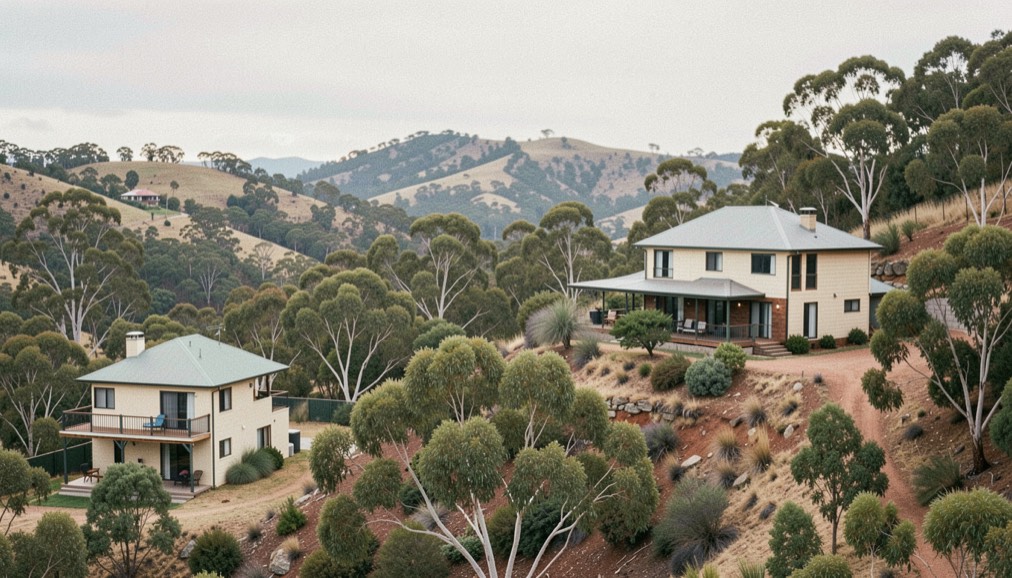
Price per square foot is the first number everyone reaches for, and in Rancho Santa Fe it is usually the wrong one. The ratio works tolerably well in a subdivision of similar lots and similar plans, where the main variables are condition and finish. It works badly across a landscape where one home sits on a groomed acre and its neighbor on a hillside of native scrub, where one house was designed by a name architect and another was assembled by a production builder, and where the boundaries of a single ZIP code contain gated club communities, historic covenant estates and rural river parcels.
What the ratio actually measures
Divide the price by the enclosed living area and you get a figure that describes the building, poorly, while saying nothing about everything around the building. In a luxury market the land is often the majority of the value, and land does not scale with floor area at all. A four acre parcel with a modest courtyard home and a four acre parcel with a vast villa can carry asking prices in the same range while their per square foot figures sit worlds apart, because both buyers were principally buying privacy, view and ground.
The ratio also inherits every quirk of how area is measured. Garages, loggias, guest houses, basements and conditioned versus unconditioned space are counted differently from one listing to the next, and appraisers, tax assessors and marketing brochures rarely agree. When the numerator depends on the season’s thin inventory and the denominator depends on someone’s tape measure policy, a single digit comparison between two homes is arithmetic dressed as insight.
A number that flattens land, light and pedigree into a single ratio will flatter someone, and it is rarely the reader.
Six questions that travel better
Instead of a ratio, ask what a comparison would need before it means anything. First, how does the land compare: acreage, usable slope, orientation, and the privacy produced by topography and easements rather than by fence lines. Second, what governs the property: a covenant with design review, a club’s architectural standards, or an ordinary association, each of which changes what you may later build or alter. Our field guide to Rancho Santa Fe neighborhoods exists precisely because these differences swallow the square foot difference.
Third, what does the view command: a long westerly panorama, a protected open space outlook, or a walled garden, since view corridors are priced like land, not like construction. Fourth, what is the provenance of the house: a documented restoration by a respected firm, a thoughtful renovation, or an attractive but generic build. Provenance behaves like art provenance; it moves value in ways no ratio captures. Fifth, what carries the property: wells, septic systems, propane, generators and long private drives are infrastructure with real costs and real lifespans, subjects we cover in the California home inspection. Sixth, how liquid is this kind of home in this kind of market, a question about pace rather than price.
On pace, a better instrument exists
When you want to know whether a market favors buyers or sellers, the cleaner instrument is months of inventory, which measures how long the current stock would take to sell at the recent pace of absorption. It is computed from counts rather than from the interior measurements of individual houses, so it survives the quirks that poison price per square foot. We explain the calculation and its reading in months of inventory for luxury markets.
None of this makes per square foot useless. Inside one street, one builder’s work and one era, it can be a rough sanity check, the way a tape measure is a sanity check on a room. Used that way, humbly and locally, it earns a small place at the table. Used to compare a golf club villa with a covenant estate, it is a machine for producing false confidence.
Price per square foot also assumes that every neighborhood is financed the same way, which is rarely true. Some streets were built through ordinary bank lending, others through public programs or community loan funds that fill gaps private capital leaves behind. That history shapes lot sizes, upkeep, and how quickly a district recovers after a downturn, so two houses with identical square footage can sit in very different financial landscapes. Readers who want the mechanics behind those differences can turn to our plain-language guide on how community development is financed, which explains the stages of revitalization and how CDFI loan funds reach underserved areas.
Field notes
- Price per square foot describes buildings; luxury value mostly lives in land, view, governance and provenance.
- Area measurement is inconsistent across listings, so the ratio’s denominator is already unstable.
- For market temperature, prefer pace measures such as months of inventory, and compare within a single community at a time.
Readers weighing a purchase will find the ownership mechanics, from escrow habits to property tax behavior, in our guide to buying a home in California, and the architectural vocabulary that gives these houses their coherence in California ranch architecture. Corrections and arguments, especially from appraisers, reach the editors through the contact page.