What to do about a clay tile roof after a storm
After wind, hail or a heavy storm, look from the ground, photograph everything, and let a roofer climb. A plain checklist for owners of tile roofs.
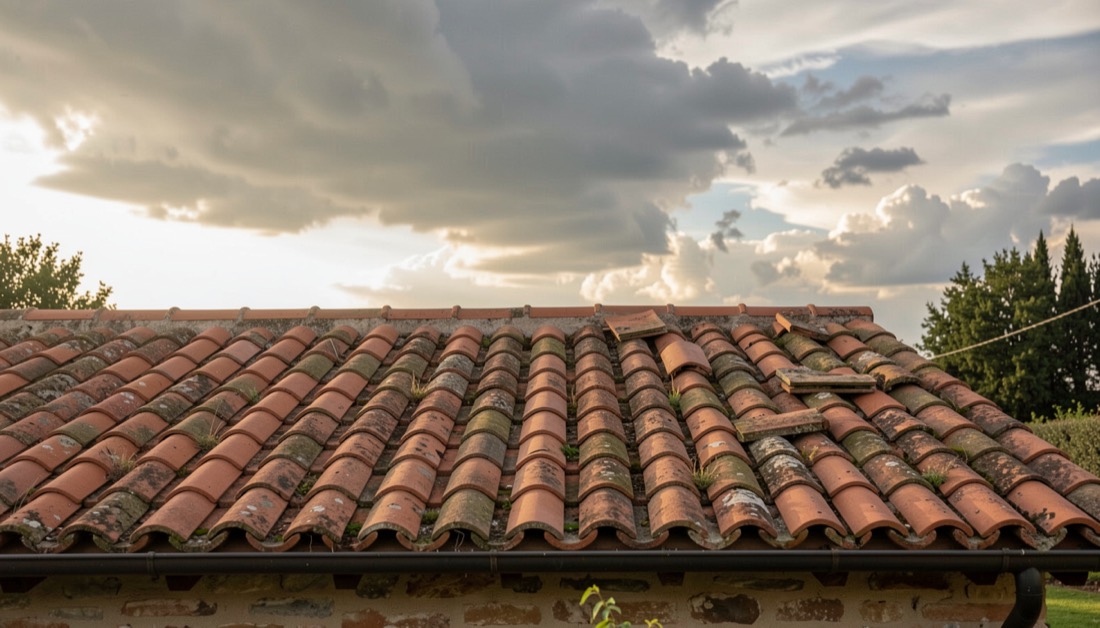
After a storm, a clay tile roof should be checked from the ground first, with binoculars or a phone zoom, and only then by a roofer who is paid to climb. Look for tiles that have slipped, cracked or gone missing, for ridge caps that have shifted, and for debris packed into the valleys. Photograph everything with the date visible, because the same pictures serve the repair quote and any insurance file.
What should you check from the ground after a storm?
Start at the edges of the lot rather than at the front door. Walk the perimeter slowly and look for pieces of tile in planting beds, on the drive or in gutters. A fragment of terracotta on the ground is the quickest sign that something above has moved. Then step back far enough to see whole slopes at once. A healthy tile roof reads as a set of straight, evenly spaced lines; a slipped tile breaks the line, and a missing one leaves a dark gap where the underlayment shows.
Roof damage after wind or hail is a question every owner meets sooner or later, in any country, and the first steps are much the same everywhere. A roofing company in central France is a handy illustration: Toitures du Val de Cher works around Montluçon and describes a routine in which the homeowner takes photos from the garden, the crew calls back, and a visit on the roof comes before any quote. The order matters more than the country. Pictures first, climbing later, and never by the owner.
Go inside as well. Open the attic hatch with a flashlight on a dry day and look for daylight where there should be none, for damp rafters, for stained insulation, and for a musty smell that was not there last month. In a house with a vaulted ceiling, look for new brown rings on the plaster. Water travels along rafters before it drops, so a stain is often a few feet from the actual opening.
The roof you cannot see from the garden is the one that leaks first, and the safest inspection starts with both feet on the ground.
Why do clay tiles fail in some places more than others?
Clay is hard and brittle. It survives decades of sun and rain, and it can still crack under a branch, a ladder foot or a heavy footstep. In North County San Diego the common culprits are wind-driven debris, eucalyptus and oak limbs, the foot traffic of other trades such as solar installers and gutter cleaners, and age. Rare hail can chip glazed or thin tiles, and a heavy winter rain finds every hairline crack in a roof that has not been looked at for years.

The tile is only the visible layer. Beneath it sits an underlayment, the membrane that actually keeps water out, and the tiles mostly shed water and protect that membrane from sun. A roof can have dozens of cracked tiles and stay dry for a season, or one slipped tile over a worn underlayment can let in a stream. That is why a roofer looks at fasteners, flashing and the condition of the membrane beneath the tile, and not only at the count of broken pieces.
Houses in the Spanish Colonial Revival tradition, which we describe in our essay on Lilian Rice and the village architecture, carry tile as a defining feature, so a repair is also a question of matching. Replacement tiles should come close to the original profile, color and weathering, and an older roof often needs tiles salvaged from a hidden slope rather than a fresh batch whose color jumps out from the rest.
When is a repair enough, and when does the roof need more?
A repair is enough when the damage is local, the underlayment is sound and the surrounding tiles are firmly seated. Replacing a handful of cracked pieces, resetting a ridge cap and sealing a flashing joint are routine jobs that take a day. A larger intervention is worth considering when tiles are lifting across a whole slope, when the roofer finds the underlayment brittle or torn, or when the same leak returns after a repair.
The deeper option is to lift the tiles, replace the underlayment and lay the same tiles back, which keeps the look of the house and renews the part that actually fails. It costs more than patching and far less than a new roof, and it is often the right answer for a tile roof that is old but whose tiles are in good shape. Ask the roofer to explain which of the two situations you are in, and to show photographs of the underlayment, not only of the surface.
Do not accept an urgent recommendation without evidence. A good roofer shows the problem on a photo, names the parts involved and separates the urgent work from the work that can wait for a dry month. The same discipline applies when you buy a house. The roof certification described in our guide to the California home inspection exists for exactly this reason: a visual look from the street does not say how much life is left in the layer beneath the tile.
What belongs in the file for the insurer?
Keep a simple folder, paper or digital, for each event. Put in it the date and time of the storm, photographs of the roof from several angles, pictures of tile fragments on the ground, photos of any interior staining, the roofer’s written description and the quote. Notify the insurer within the period set in the policy, which differs from one contract to another, and ask what the policy says about wind and hail, deductibles and the difference between sudden damage and wear. Wear and age are generally treated differently from a storm.
Take the pictures before any temporary repair, then photograph the temporary repair too. A tarp over an opening is a reasonable emergency step, and the receipt for it belongs in the file. Do not throw away broken tiles until the claim is settled, since an adjuster may want to see them. If you disagree with an assessment, the written roofer’s report with dated photos is the strongest document you will have.
What should a roofer’s visit include?
A proper visit covers the whole roof, not only the spot you pointed to. The roofer should walk the slopes carefully, since tiles break under careless weight, check ridges, hips, valleys and every penetration such as chimneys, vents and solar mounts, and open the eaves or the attic when needed. A written quote should say which tiles are replaced, what happens to the underlayment, which flashing is renewed and how matching tiles are sourced.
Professional bodies publish general guidance on roof assessment and maintenance; the National Roofing Contractors Association is one such source, and it is a useful place to learn the vocabulary before a conversation with a contractor. Owners who also care about how a roof contributes to a house’s comfort can read our piece on solar and ground energy in one house, where the roof is part of the climate system and not only a cover.
Field notes
- Inspect from the ground first, with a zoom lens, and photograph every slope with a date.
- Look inside the attic on a dry day for daylight, damp rafters and stains.
- The underlayment, not the tile, is the layer that keeps water out; ask to see it.
- Keep one dated file for the insurer: photos, quote, receipts and broken tiles.
A tile roof rewards attention. Look at it after every serious storm and once a year in a calm week, and small repairs stay small. For the buying side of the same question, see buying a home in California.