Morning in the village of Rancho Santa Fe
A slow morning walk through the village of Rancho Santa Fe: civic center, gardens, colonnades, and the smell of eucalyptus.
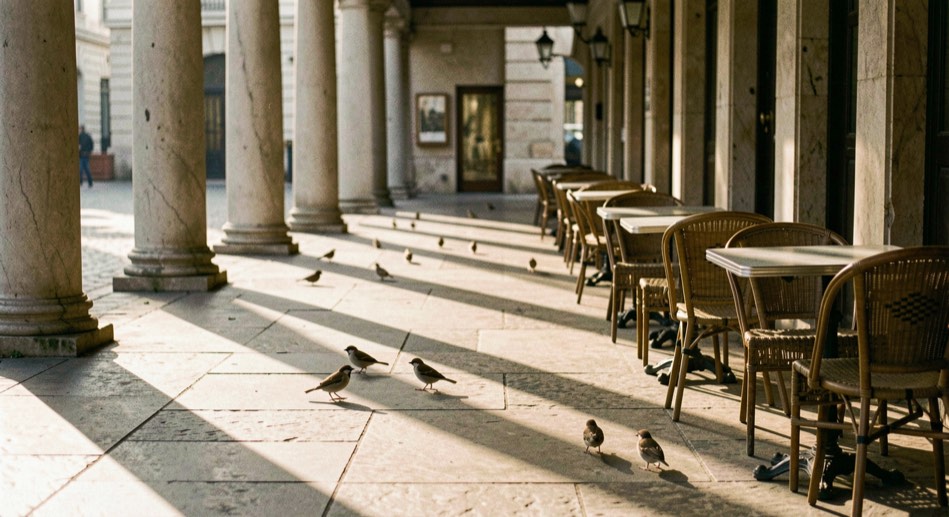
The village wakes late by suburban standards and early by its own. At seven, the arcades along the civic center are empty, their arches sorting the first sun into bright diamonds and blue shade, and the loudest thing for a mile is irrigation ticking against plaster walls. By eight there is coffee somewhere, a garden crew working a courtyard with leaf blowers off, someone riding a bicycle down the middle of the road in the way that only happens where through traffic never learned the route. This is the hour the village is most itself, and it deserves a slow account.
Under the arcades
Walk the colonnade and the morning composes itself in sections. Plaster piers, whitewashed and slightly cool to the shoulder. Clay tile underfoot, worn at the edges where a century of shoes has rounded the joints. Bougainvillea doing its tropical worst against a downspout, and beyond the arches, the long low facades Lilian Rice drew a hundred years ago, doing their patient work of making a commercial street feel like a cloister. The architecture is documented in our essay on Rice and the Spanish Colonial Revival, but documents do not record the smell: cut grass, dust, and the particular camphor sweetness of eucalyptus that stands in for morning all over this valley.
The shops open in no particular order. A gallery light first, then a café putting tables out, chairs scraping granite. The tables arrange themselves in shade with the precision of a solar instrument, and by nine the shade has migrated two tables over, and so has everyone sitting at them. A village that was planned around courtyards and arcades before the automobile finished conquering California retains, in its bones, an older idea of morning: brief conversations, unhurried transitions, errands that combine into a walk.
By eight the arcade belongs to sparrows, gardeners and one patient dog; the day is organized around shade.
Out past the gardens
Leave the commercial core on any of the residential lanes and the scale changes within a block. Hedges grow eight feet high, drives curve away behind olives, and the houses present gates and garden walls to the street, porches turned inward to their courtyards the way the old plans intended. A rider goes by on the bridle path that follows the road edge, hooves almost silent in the sand, horse and rider both unimpressed by the morning. The trail network’s story, how it came to thread private land for miles, is told in our bridle trail piece; on a morning like this it simply looks like the most natural thing in the world, a lane of sand through a woodland, and its artificiality, an entire century of agreements, is exactly what makes the naturalness possible.
The walk ends near the corner of La Granada and Paseo Delicias, where the morning crowd thins and the eucalyptus gives way to open sky. Homes in and around the village carry their own histories, and buying one asks for a different kind of attention than a coastal condo: wells, septic systems, older additions, and outbuildings that a standard report may not reach. For country properties, it helps to understand the inspection before closing, what it covers and what it leaves to specialty reports. The village is pleasant at any hour; the paperwork behind its houses rewards the same patience.
The gardens along these lanes are worth walking slowly, because July is their off season and therefore their honest one. Lavender and rosemary carrying the fragrances, olive canopies carrying the shade, granite paths carrying everything else, and the gold grass beyond the walls announcing the real calendar of the dry summer garden. Somewhere a generator runs a well pump; somewhere else, nothing at all runs, and the silence has texture.
The village keeps its own quiet schedule, and mornings here are measured in small, ordinary steps: a gate opening, a sprinkler finishing its cycle, a delivery truck idling near the civic center before the shops unlock. Other places run on timetables just as strict, though the details differ. Readers who want to see how one large city organizes the same daily chores, from curbside set-out times to container rules and holiday shifts, will find that guide elsewhere in this magazine. The contrast is useful: Rancho Santa Fe hides its routines behind eucalyptus and stucco, while denser cities must post them in plain writing.
Why the journal keeps coming back
A place is not its statistics, and this village’s statistics, wealth per acre, ages of foundations, would misdescribe it anyway. What it is, on a weekday morning, is a small composition of shade, sand and courtesy, planned by people who believed a beautiful morning could be engineered and maintained by people who appear, so far, to agree. The journal will keep recording it: the fog mornings of June, the first rain smell of November, the winter light lying flat and gold across the civic center lawn. For the fuller geography, the neighborhood guide maps what lies past the hedges; for now, the sparrows have the arcade, and the day is organized around shade.
The walk ends where the village meets the residential streets, and the same eucalyptus shade that cools the civic center also falls across the porches and stair rails of the surrounding houses. For readers who decorate those entries in December, the magazine's guide to fresh wreaths and garland explains how a wreath is built by hand, how noble fir differs from a mixed evergreen mix, and how to judge how much garland a staircase needs before anything is hung. It is a short step from the morning walk to the work of dressing a house for winter.
Field notes
- The arcades, courtyards and inward facing gardens are Lilian Rice’s plan working as intended, a century on.
- Mornings belong to walkers and riders; the bridle paths follow the road edges and the quiet is genuine.
- The journal records seasons here; this entry is July, read again in November for the rain.
Continue with the Covenant, the agreement that keeps these mornings intact, or browse the journal archive for the seasons as they pass.